
Attraction
"Dimitrie Brândză" Botanical Garden
The "Dimitrie Brândză" Botanical Garden in Bucharest, at 32 Cotroceni Avenue, covers 17.5 hectares and holds over 10,000 plant species, arranged in thematic sections including medicinal plants, aquatic plants, and tropical greenhouse collections. Founded in 1860 by Dr. Carol Davila, the institution belongs to the University of Bucharest and combines scientific research with its role as an educational space open to the public. It is the capital's leading resource for living botanical documentation.
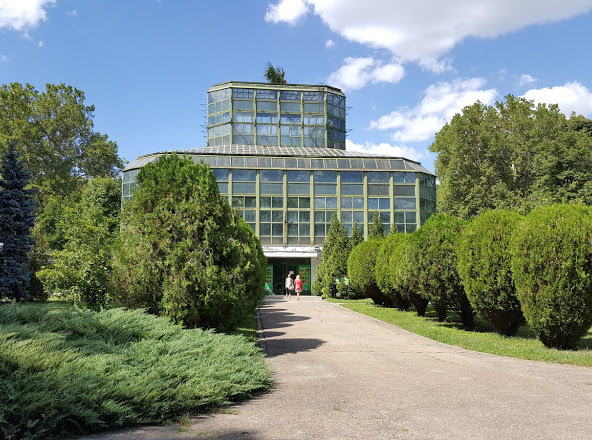
The "Dimitrie Brândză" Botanical Garden of the University of Bucharest is one of Romania's leading institutions in its field, located at 32 Cotroceni Avenue, in the city's 6th district. It was founded on 5 November 1860, by decree signed by ruler Alexandru Ioan Cuza, on the initiative of Dr. Carol Davila, attached to the Faculty of Medicine and Pharmacy, originally meant to provide fresh medicinal plants and teaching material for students. Its first site, just 7 hectares, was on Cotroceni Avenue, under the direction of botanist Ulrich Hoffmann, the institution's first director.
In 1874, the garden was moved to the city center, onto the grounds of the former Vasile Șuțu Palace (today's University Square area), coming under the University of Bucharest. From that year, its direction passed to professor Dimitrie Brândză, who, unhappy with the poor conditions, obtained by decree in 1884 the land and funds to lay out the garden at its current Cotroceni site — a process completed in 1891, with the construction of the first greenhouses, modeled on those in Liège. In recognition of his efforts, the garden was named "Dimitrie Brândză" in 1994.
The garden now covers about 17.5 hectares (the outdoor exhibition area, out of the complex's total 18.2 hectares) and holds over 10,000 plant species and varieties from every climate zone on Earth. Its collections are organized into thematic sections: the systematic garden, the ornamental garden, the medicinal and aromatic plants section, the rosarium, the aquatic plants section, and greenhouses housing tropical and subtropical species — cacti, palms, bromeliads, and orchids. The old greenhouse, built at the end of the 19th century, was renovated in 2011.
The garden operates both as a public visitor space and as a research and botanical education institution within the University of Bucharest, and holds an herbarium with over 300,000 specimens. It is reached by public transport — tram 41, buses 336 and 368, Grozăvești stop — or by metro to Eroilor station, followed by a roughly 1.5 km walk. Worth visiting for the exceptional diversity of its living botanical collections and its documentary value regarding both world and native flora.
Soseaua Cotroceni 32 Bucuresti