
Attraction
Constanța Seafront
The Constanța Seafront is the developed coastal strip bordering the city to the east, along the Black Sea. The natural cliff, cut into loess, limestone, and green schist, rises 20 to 35 metres, but the promenade in the peninsula area is partly man-made: around 1910, the engineer Anghel Saligny pushed the cliff edge 40 to 60 metres out into the sea, in reinforced concrete and stone, to make room for the Casino. The seafront overlies ancient Tomis and holds the Casino, reopened in May 2025 after five years of restoration, the Aquarium, and the Genoese Lighthouse.
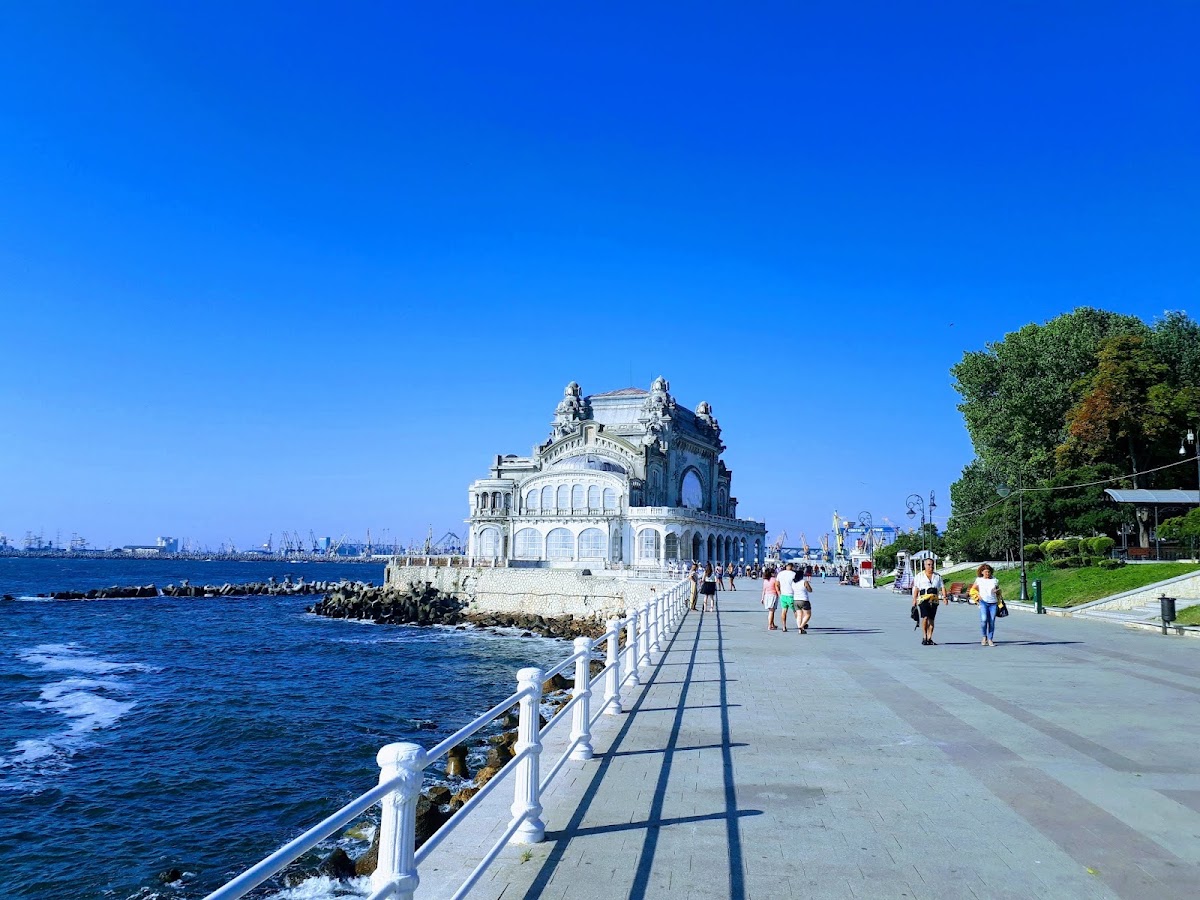
The Constanța Seafront borders the city to the east, along the shore of the Black Sea. In Constanța the term covers two overlapping things: the geographical cliff, the high, steep bank cut by marine erosion, and the artificially developed strip laid out for walking along it.
The present-day cliffs of the Romanian coast are cut into loess deposits, limestone, and green schist, with heights ranging from 20 to 40 metres. Starting at Capul Râpa, near the "Pescărie" area, the cliff rises southward to about 35 metres, then drops to 10-15 metres.
The peninsula stretch, the most visited, is not a natural bank. The Casino was raised on ground that originally lay beneath the sea: the engineer Anghel Saligny, then director of works at Constanța Port, moved the cliff edge 40 to 60 metres seaward, using reinforced concrete and stone, to create the promontory on which the foundations were laid. In practical terms, the entire seafront in this sector was engineered around 1910.
The seafront overlies ancient Tomis, a Greek colony founded in the 6th century BC by settlers from Miletus, later a major centre of the Pontic world under Roman rule. The ancient remains lie immediately nearby, in the peninsula.
The centrepiece of the seafront is the Casino, designed by the architect Daniel Renard in Art Nouveau style and inaugurated on 15 August 1910, in the presence of Prince Ferdinand. Its history is one of ruptures: a field hospital in both world wars, damaged by bombing in 1916 and 1941, restored in 1951 by the labour of some hundred political prisoners brought from Poarta Albă prison, then a trade-union culture house. Some of those prisoners hid notes in the walls bearing their names and sentences, discovered only during the 2020 works. The building was closed to the public in 2008 for fear of collapse and stood derelict for years. Restoration began in January 2020, cost roughly 37 to 40 million euros, and covered 1,230 ornaments, over 1,500 square metres of marble, more than 2,222 square metres of painting, and 154 square metres of stained glass. The Casino was handed over to Constanța City Hall in March 2025 and reopened to the public on 21 May 2025. It now operates purely as a cultural centre, hosting exhibitions, events, and performances.
Also on the seafront, beside the Casino, stands the Aquarium, built between 1955 and 1958, at its opening the second aquarium in Romania after the one in Bucharest. It holds around 2,000 fish of 60 species, grouped in three sections: marine, native freshwater, and exotic. Between the Casino and the Navy Command rises the Genoese Lighthouse, a monument which, despite its name, has nothing to do with the Genoese.
The Constanța Seafront rewards walking for the unusual density of layers stacked within a few hundred metres: a Greek city of the 6th century BC, an engineered promenade won from the sea in 1910, an Art Nouveau jewel with political prisoners' messages sealed in its walls, and a period aquarium, all above a loess bank the sea keeps eating away.
Faleza Nord Constanta judetul Constanta