
Attraction
Roman Mosaic Edifice
The Roman Mosaic Edifice in Constanța houses the largest polychrome Roman-Byzantine mosaic ever found in the Balkans. Raised at the turn of the 3rd and 4th centuries AD in ancient Tomis, the complex ran across three terraces linking the city to its ancient harbour. The upper hall held a mosaic floor of roughly 2,000 square metres, of which a portion survives today. Discovered by chance in 1959, the monument reopened to the public on 14 November 2025, after a major restoration.
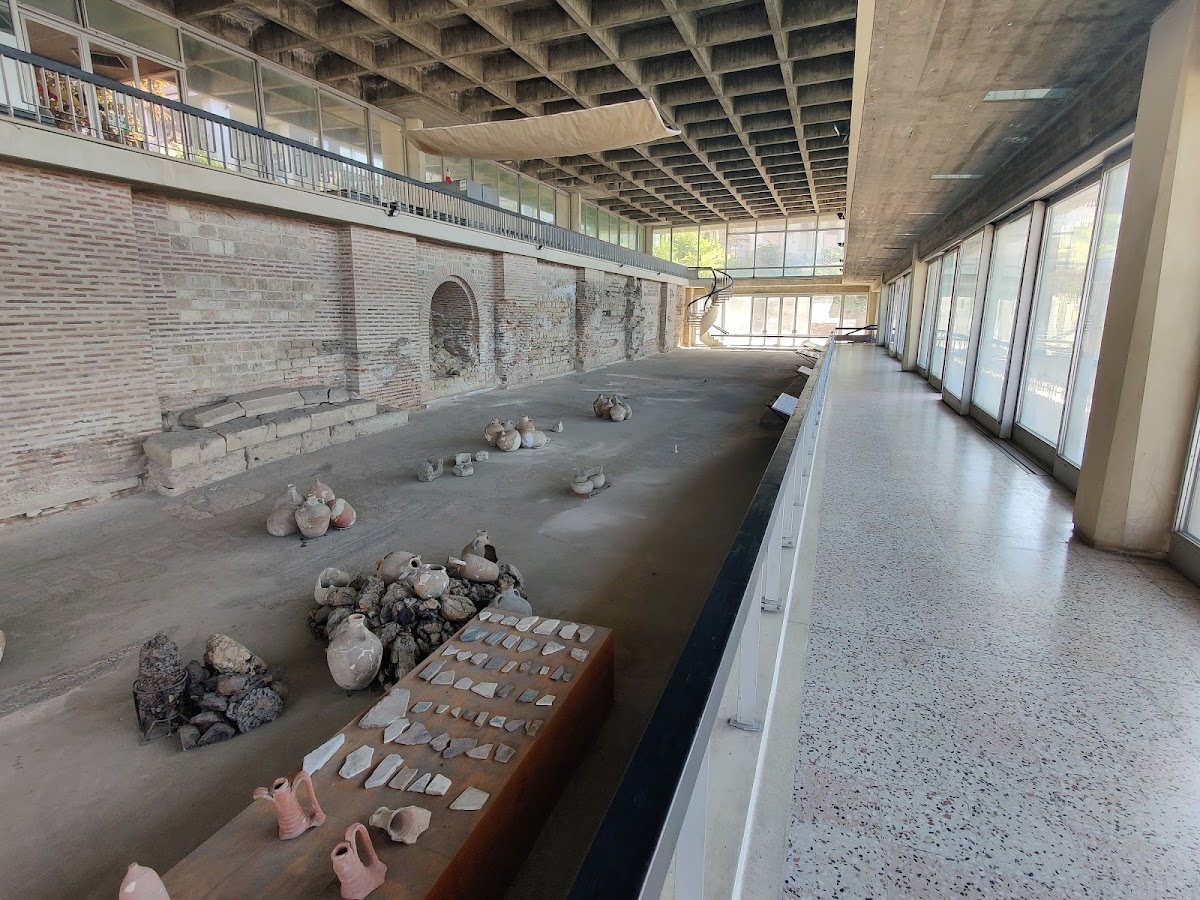
The Roman Mosaic Edifice stands at 12 Ovidiu Square, in the historic centre of Constanța, on the site of ancient Tomis, immediately next to the National History and Archaeology Museum. It is a listed historic monument, coded CT-I-m-A-02553.05, and it houses the largest polychrome Roman-Byzantine mosaic yet discovered in the Balkan region.
The edifice was raised at the turn of the 3rd and 4th centuries AD, possibly under Constantine the Great, on the site of earlier harbour buildings. It formed part of a complex scheme to stabilize the Tomitan cliff: the bank was terraced and lined with heavy-walled buildings facing the harbour zone. Three levels, laid out on three terraces cut into the bank, open toward the ancient port while holding back the earth rising above them. The complex served as the hub of Tomitan commercial activity until the 6th century, when it ceased to function as the city declined and was abandoned.
On the upper terrace, at the level of the ancient city, lies a hall of roughly 2,000 square metres, a hundred metres long and twenty wide, most likely roofed in antiquity by a great vault carried on pillars. The floor is composed of a sequence of rectangular fields alternating with squares enclosing circles, combining geometric and plant motifs with varied stylizations. The only surviving zoomorphic motif is a white dove, hidden among leaves emerging from a stylized vessel. The hall's walls were entirely faced in white and coloured marble, decorated with zoomorphic, anthropomorphic, plant, and geometric motifs. The whole formed a fitting setting for political, cultural, and social gatherings, and for the financial and commercial business of a port city of Tomis's standing.
Descending toward the harbour, the next terrace holds a row of eleven vaulted rooms, facing the sea and opening onto a paved space, probably a small square. Their principal function was storage. In two of them, beneath collapsed vaults, archaeologists found the cargo of a merchant vessel that had docked in the Tomitan harbour: amphorae holding pigments and resins, anchors, ingots, weights, statuettes, oil lamps, marble facings, pilaster capitals. Some of these pieces are displayed today in the former storerooms, alongside epigraphic monuments recovered from various centres in Dobruja.
The monument was found by chance in 1959, during municipal works in Ovidiu Square, and successive archaeological campaigns followed. Though built of good materials, the floor deteriorated after the edifice was abandoned. Of the original 2,000 square metres, only a portion survives; sources give figures between 400 and 850 square metres.
The restoration, undertaken by Constanța County Council and funded from European sources, began as a project in 2018, but the actual works started only at the end of 2022, after several tenders drew no bidders. Execution fell to the Italian firm Giano Restauri, with specialists who had worked at the Colosseum. The project covered restoration of the mosaic, rehabilitation of the protective building, climate control, fire safety, surveillance, and lifts for visitors with disabilities. The monument reopened to the public on 14 November 2025, on Dobruja Day.
The Roman Mosaic Edifice rewards a visit for the scale of a floor without equal in the Balkans, for a terraced architecture that renders in stone the relationship between an ancient city and its harbour, and for a single white dove, sole survivor of all the zoomorphic motifs that once covered the ground.
Piata Ovidiu Constanta judetul Constanta