
Attraction
Hajongard Central Cemetery
The Central Cemetery of Cluj-Napoca, also called Hajongard (Házsongárd in Hungarian), was opened after the plague of 1585 and covers about 14 hectares on Avram Iancu Street. Many notable figures of Transylvania are buried here, and the whole cemetery is a listed historic monument.
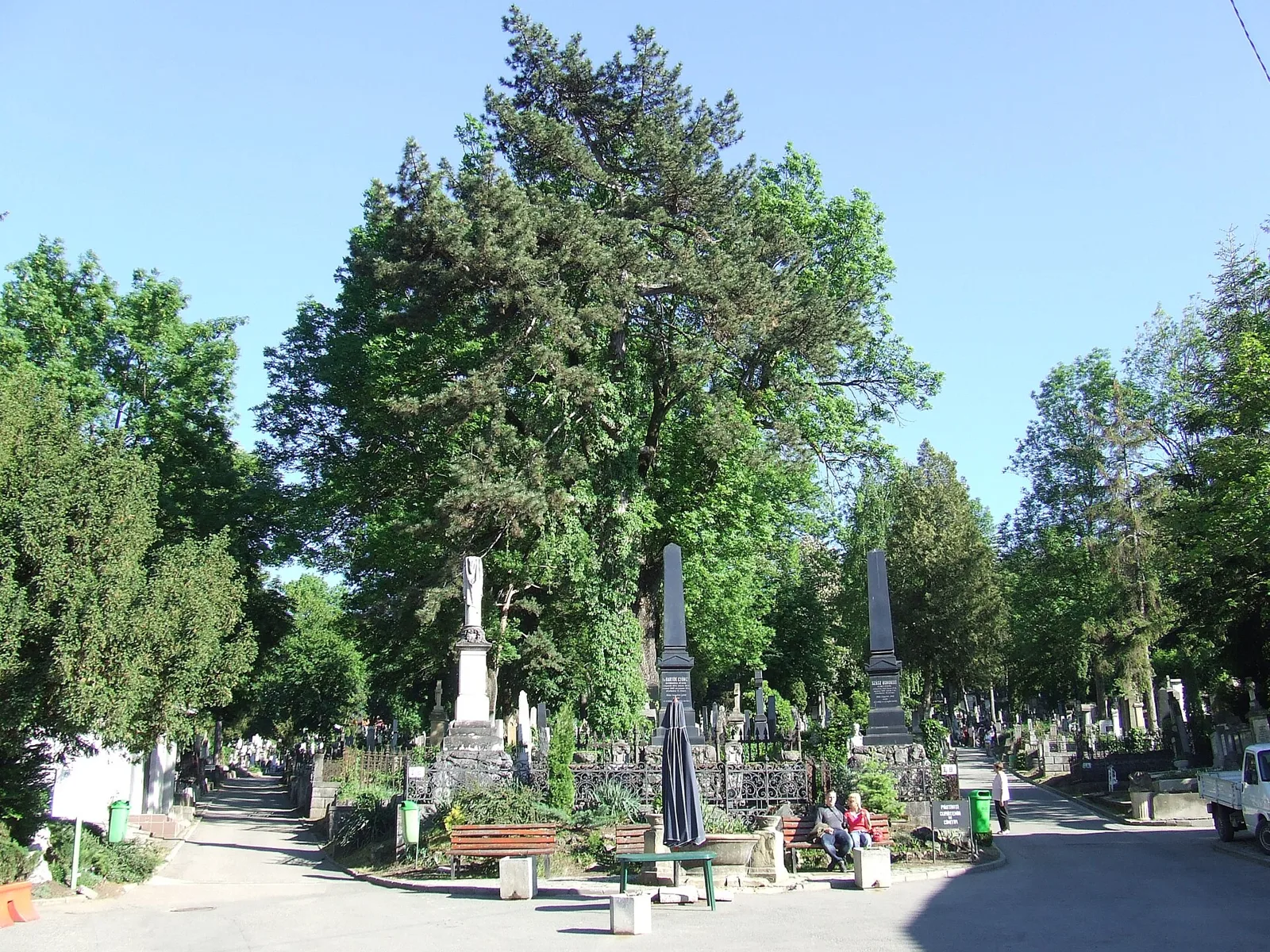
Foto: Christo, CC BY-SA 4.0, via Wikimedia Commons
The Central Cemetery, also known as Hajongard Cemetery (Házsongárd in Hungarian), lies in Cluj-Napoca at 26-28 Avram Iancu Street, on the hill south of the old city centre. It covers about 14 hectares.
The decision to open the cemetery was taken on 11 May 1585, during a plague epidemic, when the old graveyard around St. Michael's Church was no longer enough. From the start the cemetery had a mixed denominational and ethnic character: there are mainly Reformed and Unitarian plots, an Evangelical Lutheran wing enlarged by a donation in 1739 and a Heroes' Cemetery from 1914. In 1885 the cemetery was reorganised, with plots marked out and trees planted.
Visitors can see the vaults of noble families (Bánffy, Bethlen, Mikó) and the graves of figures such as the biologist Emil Racoviță, the writer Ion Agârbiceanu, the architect Károly Kós, the physician Iuliu Hațieganu, the historian Constantin Daicoviciu, the composer Gheorghe Dima and the scholar János Apáczai Csere. One of the oldest surviving gravestones, dated 1599, stands in the Lutheran section. The main entrance is on Avram Iancu Street, about a 10-minute walk from Unirii Square.
The cemetery is listed in the List of Historic Monuments as a site, code CJ-IV-s-B-07839, and hundreds of graves and vaults inside have their own monument codes. It is a working cemetery, so visits should respect its role as a burial place.
Did you know that the name Hajongard most likely comes from the German "Hasengarten", meaning "rabbit garden"? Some linguists, however, think the original form was "Haselgarten", "hazel garden". The name first referred to the hill south of the town walls, over which the cemetery later spread.
Strada Avram Iancu 26-28, Cluj-Napoca, județul Cluj