
Attraction
Râșnoava Gorge
Râșnoava Gorge is a karst formation in the Postăvarul Massif, carved by the Râșnoava stream through Jurassic limestone, with vertical walls 60-70 meters tall in its narrowest sections. The canyon stretches for about 3 km. The area is notable both for its karst geomorphology typical of the Curvature Carpathians and for the wide range of mountain activities it hosts.
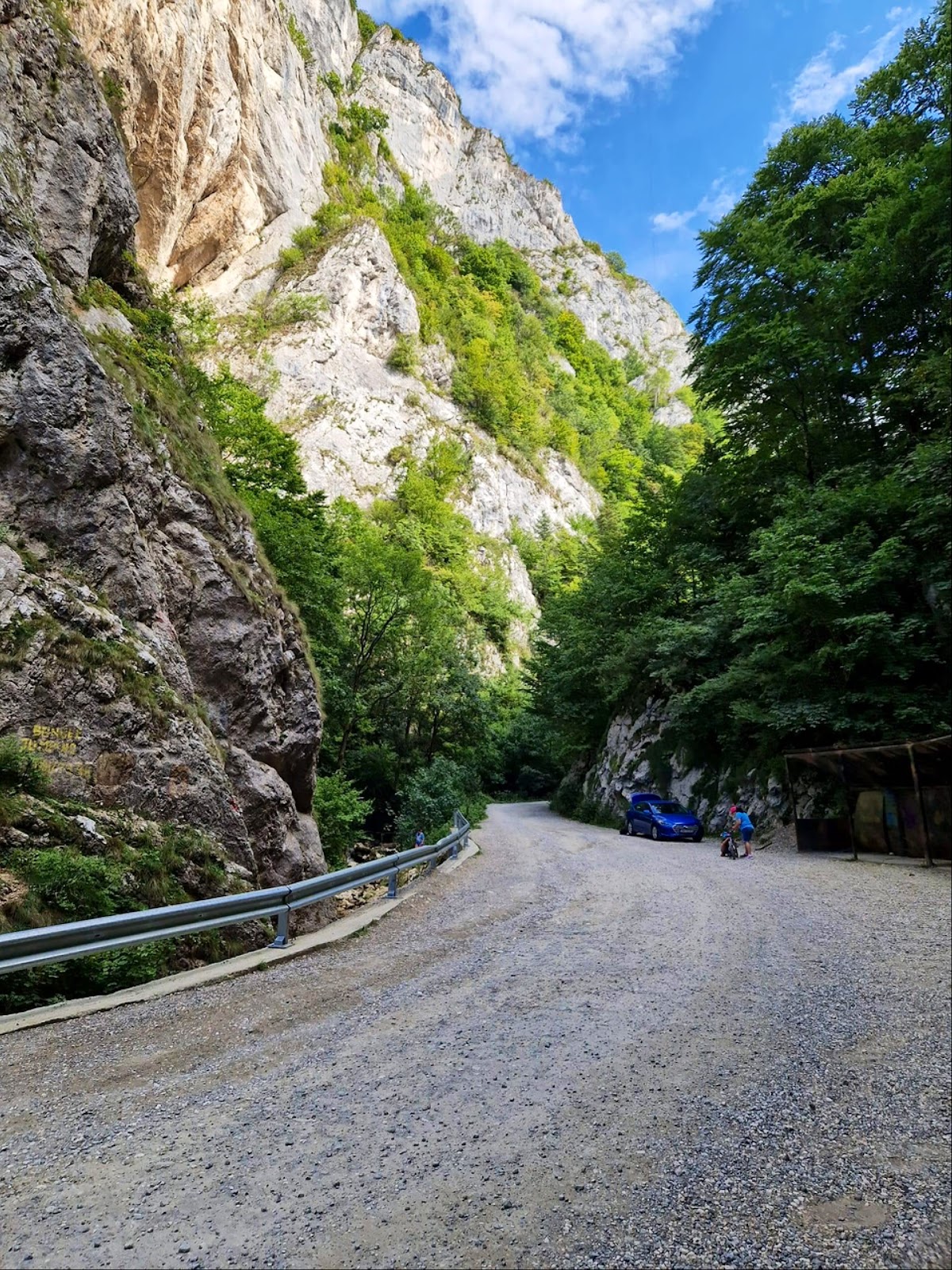
Râșnoava Gorge is a karst formation on the southern slope of the Postăvarul Massif. The gorge was carved by the Râșnoava stream, which over time eroded the massif's Jurassic limestone, creating rock walls 60-70 meters tall in the narrowest sections, where the valley floor narrows to just 10-12 meters wide. The canyon is about 3 km long. From Postăvarul Peak (1,799 m), a white limestone ridge — Muchia Cheii — descends west-southwest, ending abruptly right at the gorge.
Geologically, the dominant rock is Mesozoic limestone, similar to other karst formations in the Curvature Carpathians. Vegetation varies from the slopes, dominated by beech, spruce, and fir, to the valley floor, with a steppe-like landscape of herbaceous plants adapted to the shade and high humidity inside the gorge — ferns, moss, and rock-dwelling species cover the limestone walls. Wildlife includes endemic species such as the saker falcon, golden eagle, Carpathian brown bear, lynx, deer, and roe deer.
Râșnoava Gorge is a well-known destination for mountain sports: rock climbing (with famous routes such as Santinela Cheilor and Surplombele de Aur), sport climbing, via ferrata (Romania's first, 450 m long), rappelling, bungee jumping (one of the tallest natural bungee installations in Eastern Europe, with a 137.5 m drop), and a zip line (150 m long, suspended 140 m high). Worth visiting for its karst geology, typical of the Carpathians, and for the range of mountain activities available in a spectacular natural setting.
Masivul Postăvarul Râșnov