
Attraction
Râșnov Fortress
Râșnov Fortress is a medieval peasant fortress built on a rocky hill at an altitude of approximately 650 m, dominating the town of Râșnov in Brașov County. Initially constructed by the Teutonic Knights and the Saxons of Țara Bârsei in the 13th century as a refuge for the community against invasions, it is one of the best-preserved peasant fortresses in Transylvania. It withstood attacks for five centuries and capitulated only once, in 1612, to Prince Gabriel Báthory — and even then not by force of arms, but because the besiegers cut off access to the water spring outside the walls.
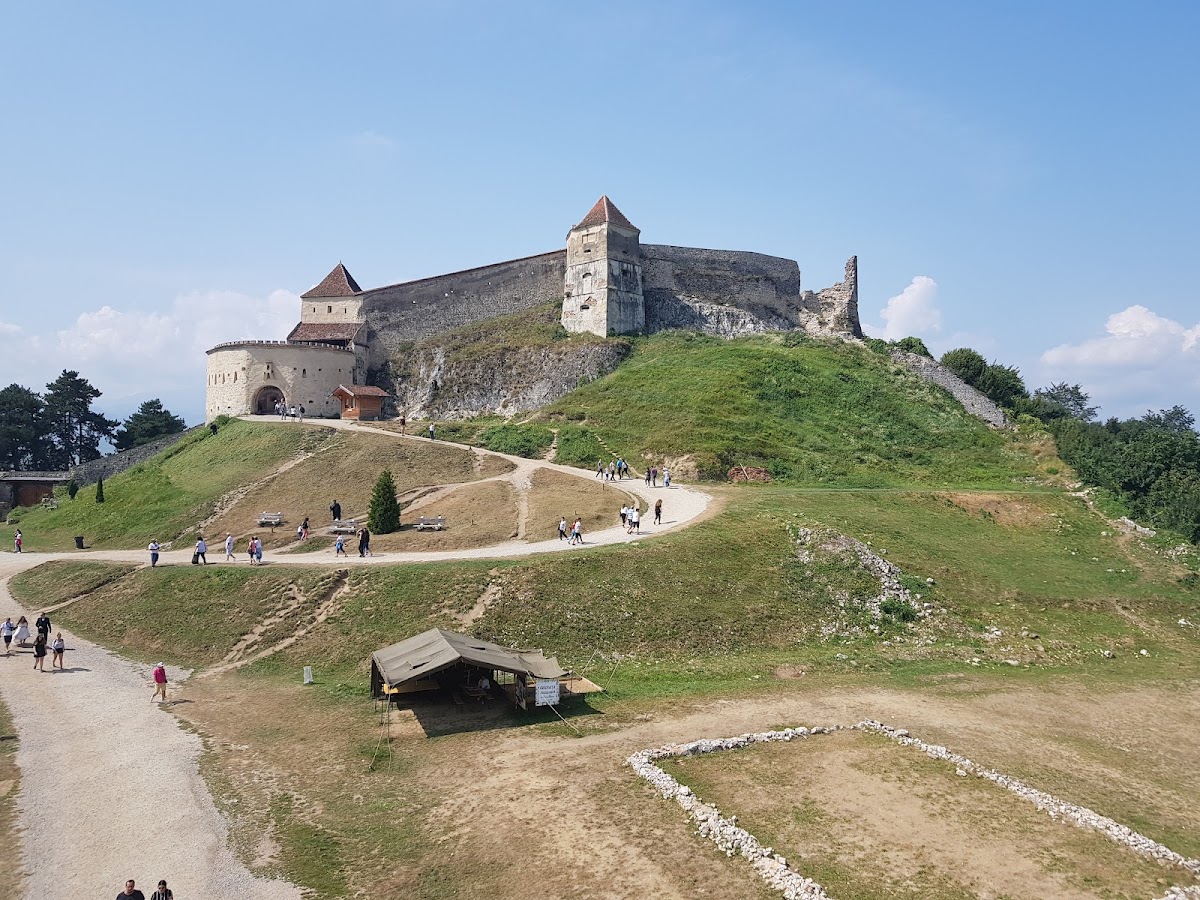
Râșnov Fortress is a medieval fortification situated on a rocky, limestone hill dominating the town of Râșnov, Brașov County, surrounded by forest. The earliest structures were most likely erected by the Teutonic Knights at the beginning of the 13th century (around 1211–1225), initially from wood and earth, then rebuilt in stone by the Saxon community after the crusaders were expelled. At a time when Bran Castle did not yet exist, Râșnov was a trading and toll point on the commercial route crossing the Bran Pass. The fortress covers approximately 3,500 m² and is defended by eight rectangular towers and one polygonal tower, with a single entrance. Unlike noble fortresses, Râșnov is a peasant fortress — built and maintained by the inhabitants of Râșnov, Ghimbav and Cristian as a collective refuge against Ottoman and Tatar invasions. Inside the walls, two-storey cottages were built to shelter villagers in times of hardship, along with a school and, from 1650, a chapel. The fortress withstood the Turkish sieges of 1436 and 1441 and the Tatar invasion of 1335, and was conquered only once in its history: in April 1612, the Prince of Transylvania Gabriel Báthory occupied the eastern slope and blocked the defenders' access to the Izvorul Tăinuit spring outside the fortress, forcing a surrender through thirst. The people of Râșnov bought back the fortress in 1613, paying 3,000 florins. That siege demonstrated the need for an internal water source, and so between 1623 and 1640 the fortress's famous well was dug directly into the rock — between 98 and over 140 metres deep, depending on the source. A legend launched in the 1970s claims it was dug by two Turkish prisoners who were promised their freedom upon completion of the work; however, historical documents show that the well was the work of Saxon craftsmen and stonemasons hired by the Râșnov town hall, among them Boltres and Andreas from Făgăraș. The well was in use until around 1850, when the fortress was gradually abandoned. Today the fortress is an important restored medieval monument. Access is from the centre of Râșnov — on foot, by tourist transport, or by car via DN73. Dino Parc Râșnov is located nearby. The distance from Brașov is approximately 15 km.
Strada Cetății Râșnov