
Attraction
Noviodunum Fortress, Isaccea
An archaeological site on the Danube, about 2 km from Isaccea: the main base of the Roman fleet on the Lower Danube, the Classis Flavia Moesica, later a Romano-Byzantine town and an important medieval centre until the Ottoman conquest. Along the beach you can see the ruins of the northern side of the town and of the ancient port.
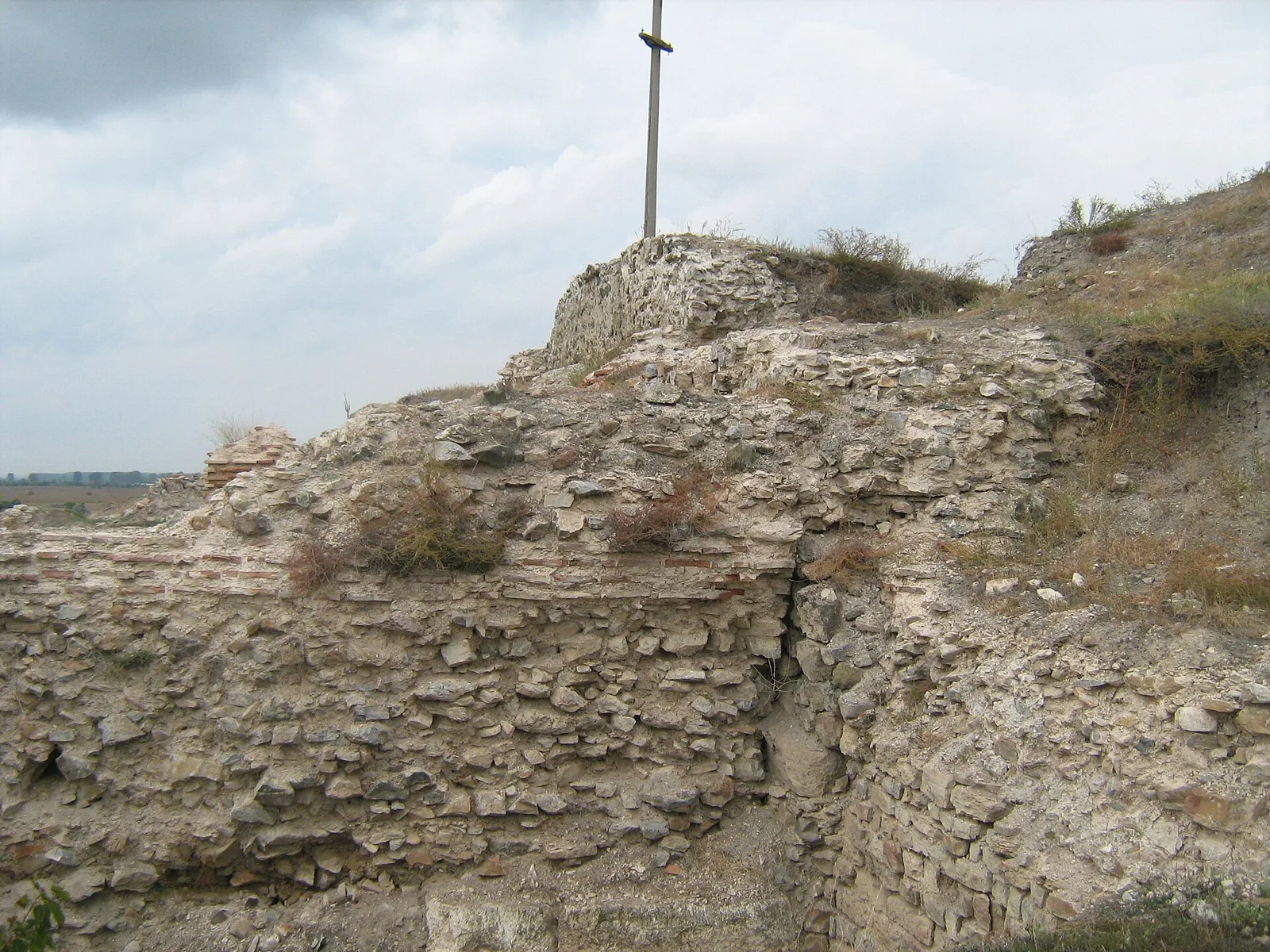
Foto: Mixolidic, CC BY-SA 3.0, via Wikimedia Commons
Noviodunum Fortress lies at the place called "Pontonul Vechi" or "Eski Kale" (Turkish for "Old Fortress"), on a promontory on the right bank of the Danube, about 2 km east of the town of Isaccea, at mile 65, near one of the most important fords of the Lower Danube. Isaccea is about 35 km north-west of Tulcea, on the E87 (DN22) road towards Galați and Brăila.
The name is of Celtic origin, and the finds show that the Roman settlement was built over a Getic one. After Dobruja was annexed to the province of Moesia Inferior under Emperor Vespasian, Noviodunum became the main base of the Roman fleet on the Lower Danube, the Classis Flavia Moesica, and the seat of detachments of the legions V Macedonica, I Italica and XI Claudia. It was the end point of the military and trade road that crossed Dobruja from Marcianopolis. At the end of the 2nd century it was raised to the rank of municipium, and in late Roman times it was the seat of the legion I Iovia Scythica and of the fleet prefect. The town survived until the middle of the 7th century; the latest coins are from Emperor Heraclius. Settlement resumed at the end of the 10th century, flourished in the 11th, suffered attacks by the Pechenegs, Uzes and Cumans and the Tatar destruction of 1242, and continued until the Ottoman conquest at the beginning of the 15th century.
The fortress measures about 350 by 250 m. To the south and east lay the civil settlement, protected by three earthen ramparts with ditches, and beyond them, for 4 to 5 km, the cemeteries; between 1958 and 1992 Gavrilă Simion excavated thirty burial mounds, half of those that exist. Today, along the beach, you can see for about 300 m the ruins of the northern side of the town and of the ancient port: two baths, houses, a basilica and the northern wall with seven semicircular towers. Excavations, begun in 1953, were resumed in 1995 by ICEM Tulcea and have explored the Great Tower, the Corner Tower and Tower A on the south-eastern side. Thousands of coins, seals, weapons and pottery have been found in the fortress and the civil settlement. In 2020, Isaccea Town Hall, ICEM Tulcea and the Pro Noviodunum Association started a project to restore and present the site, funded through the Historic Monuments Stamp programme, with a first stage devoted to the technical documentation.
The archaeological site "Noviodunum Fortress" is a historic monument of national importance, LMI code TL-I-s-A-05804 (RAN code 159696.05), comprising the fortress and its defences, the Romano-Byzantine civil settlement, the Getic settlement, the medieval settlements and the burial mounds at "Movilele Dese". Research is coordinated by the Gavrilă Simion Eco-Museum Research Institute of Tulcea.
Did you know that the Roman historian Ammianus Marcellinus tells how, in 369, Emperor Valens crossed the Danube at Noviodunum on a bridge of boats during his war with the Goths? The war ended with a peace signed on ships brought into the middle of the river, because the Gothic king Athanaric had sworn never to set foot on Roman soil.
Punctul „Pontonul Vechi” (Eski Kale), la circa 2 km est de orașul Isaccea, județul Tulcea