
Attraction
Suceava Princely Fortress
The Suceava Princely Fortress is the medieval stronghold on the eastern edge of Suceava, built by Petru Mușat in the late fourteenth century and strengthened by Stephen the Great after the Ottoman siege of 1476. It was destroyed in 1675 and is now a museum site of the Bukovina National Museum, restored in 2011-2015.
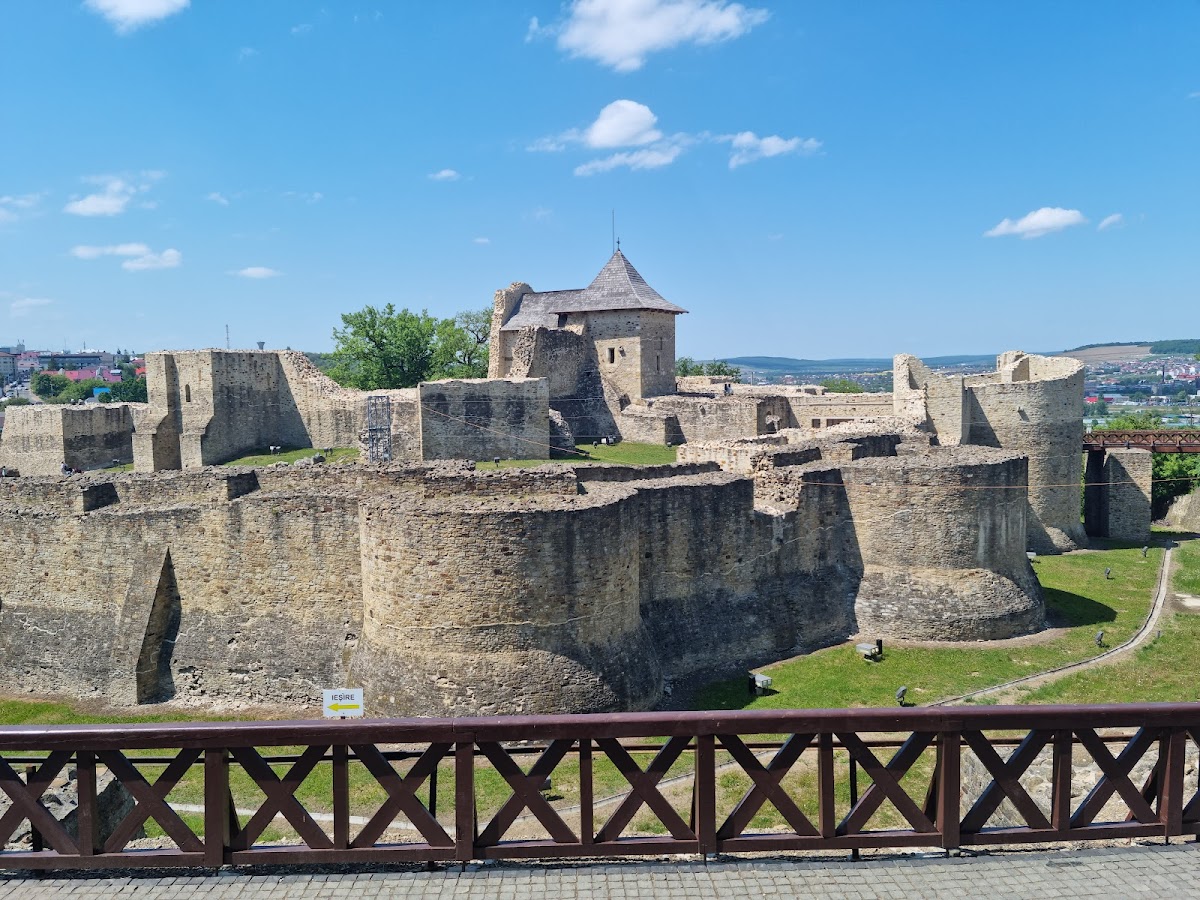
The Suceava Princely Fortress stands on the eastern edge of the city of Suceava, on the end spur of a plateau about 70 m above the floodplain of the Suceava river. It was built by Petru Mușat (1375-1391), who moved the capital of Moldavia from Siret to Suceava in 1388; the fortress is mentioned in a document of 10 February 1388. The Mușatin fort was a quadrilateral with sides of about 40 m (east and west) and 36 m (north and south), square towers at the corners and in the middle of each side and an inner courtyard, and Alexander the Good added a wall protecting the entrance.
Before 1476 Stephen the Great surrounded the fort with an enclosure wall with three square towers. In the summer of 1476 the fortress withstood the siege led by Sultan Mehmed II, after which the prince doubled the enclosure with a wall at least 3.5 m thick and seven semicircular bastions, widened the moat and moved the entrance to the north-east side, with a bridge that had a fixed and a movable section. The fortress also withstood the sieges of 1485 (Ottoman) and 1497 (Polish, led by King John Albert).
In 1538 the fortress was taken without a fight by Sultan Suleiman the Magnificent, and after the capital moved to Iași (1564) it lost its role. Vasile Lupu partly rebuilt it, and Eustratie Dabija set up a mint here (1662-1668). In 1675, on Ottoman orders, Prince Dumitrașcu Cantacuzino had the fortress destroyed by filling it with timber and setting it on fire; the north side collapsed in the earthquake of 1684.
The architect Karl A. Romstorfer carried out the first excavations and consolidation work between 1895 and 1904, and from 1951 the site hosted Romania's first training excavation in medieval archaeology. Between 2011 and 2015 the complex was consolidated and completed through an EU-funded project, and the fortress reopened on 31 July 2016. It is run by the Bukovina National Museum and is a class A historic monument (LMI code SV-II-a-A-05449), comprising the Mușatin fort, the outer enclosure, the moat and the counterscarp wall.
Platoul Cetății, partea de est a municipiului Suceava, județul Suceava