
Attraction
The Dacian Fortress of Racoș — Tipia Ormenișului
The Dacian Fortress on Tipia Ormenișului is the largest Dacian settlement in Țara Bârsei and the only Dacian site in eastern Transylvania to have received a complete monographic publication. Located on a basalt spur at approximately 750 m altitude in the Olt Gorge, on the territory of Ormeniș commune, Brașov County, it preserves an 85-metre-long dressed stone wall and a circular sanctuary that researchers have compared to the one at Sarmizegetusa Regia. It is well worth visiting for its historical uniqueness and for the spectacular volcanic geological setting of the Racoș area.
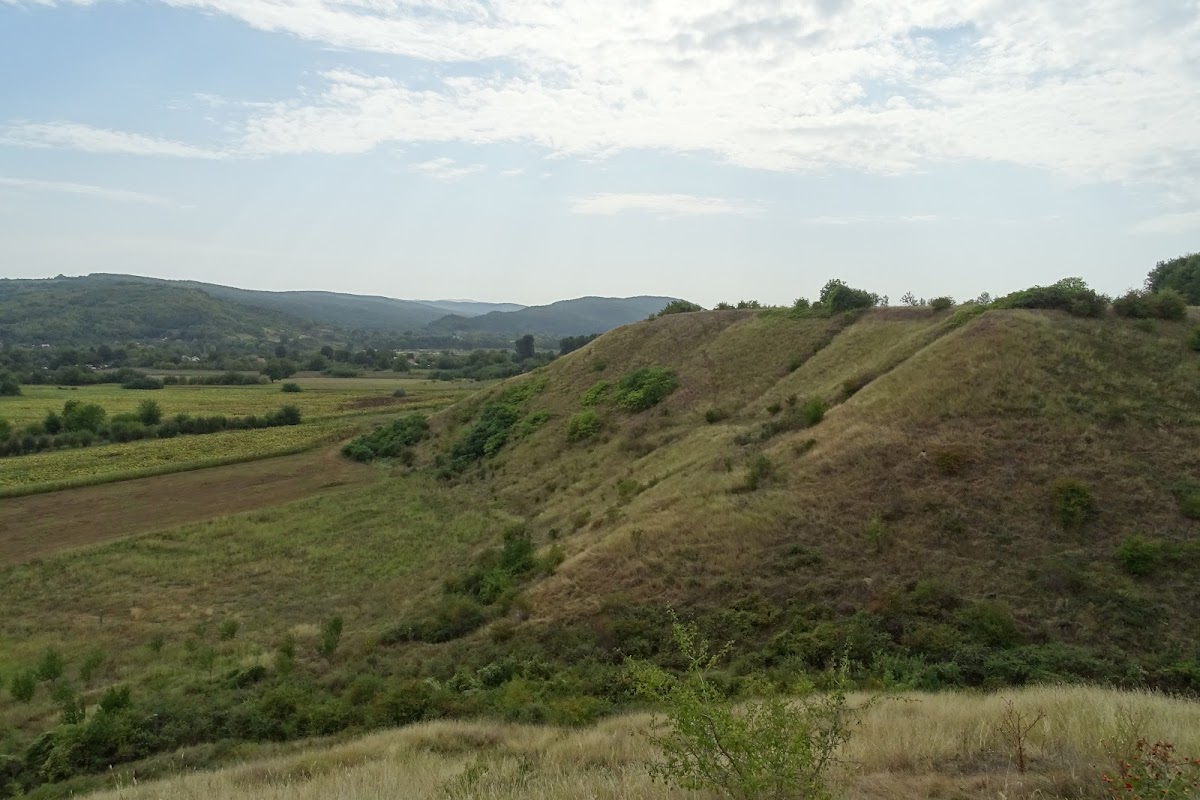
The Dacian Fortress on Tipia Ormenișului is the most important Dacian settlement in Țara Bârsei, situated on a basalt spur at 759 m altitude, on the left bank of the Olt, midway through the Racoș Gorge — a gorge nearly 17 km long, between the Munții Baraolt and the Munții Perșani. Across the river, on the right bank, stands Tipia Racoșului, the two basalt knolls guarding the entrances to the gorge. The complex of fortresses in the area extends over approximately 5 km along the Olt and includes three sites on the left bank (Tipia Ormenișului, Dealul Vărăriei, Piatra Detunată) and one on the right bank (Tipia Racoșului). The area was inhabited from the 5th century BC by the Dacian cumidavensi, a branch of the cotenses. The fortress proper was built in the mid-1st century BC on a narrow, elongated plateau, bounded to the north by a precipice with vertical walls — a natural barrier that eliminated the need for a wall on that side. On the other three sides, a complex defensive system was constructed: a wide ditch 4–7 m across, a rampart 8–11 m wide, and an 85-metre-long dressed basalt stone wall nearly 4 m thick, flanked by a palisade. The most remarkable feature of the site is the circular sanctuary on Terrace III, with an outer perimeter of 19.2 m and an inner circle of 15.5 m made of white volcanic tuff blocks, which academician Alexandru Vulpe has compared to the sanctuary at Sarmizegetusa Regia. On the upper plateau, cult buildings, possible barracks, and civilian spaces have been identified, all bearing traces of repeated burning. In one of the rooms, a large jar was discovered in 1973 bearing the Greek inscription "BASILE(US) TIAMARCO(S)" — "the vessel of King Tiamarcos" — suggesting a connection between the site and a Dacian king otherwise unknown from ancient sources. The site was discovered during the interwar period by the village priest, who carried out unscientific excavations; some of the objects ended up in Budapest. Systematic research was conducted between 1981 and 2005, initially led by I. Glodariu and later by Florea Costea. The fortress and the structures on the terraces were destroyed and burned during the Dacian-Roman wars in the early years of the 2nd century AD. The dressed stone Dacian wall was subsequently reused in the early Middle Ages.
Tipia Ormenișului, comuna Ormeniș, județul Brașov