
Attraction
Callatis Fortress
Callatis Fortress, listed in the National Archaeological Repertory, is the only former Doric colony on the shore of the Pontus Euxinus and the oldest city on the present-day territory of Mangalia, founded by Greek colonists from Heracleea Pontica. The defensive wall was built in two phases: the first enclosure at the end of the 4th century BC, and the second in the 2nd century AD, along the same alignment. The fortress complex comprises 12 monuments, including two necropolises, a Syrian-type basilica, the papyrus tomb and the enclosure wall, visible at several points throughout the modern city.
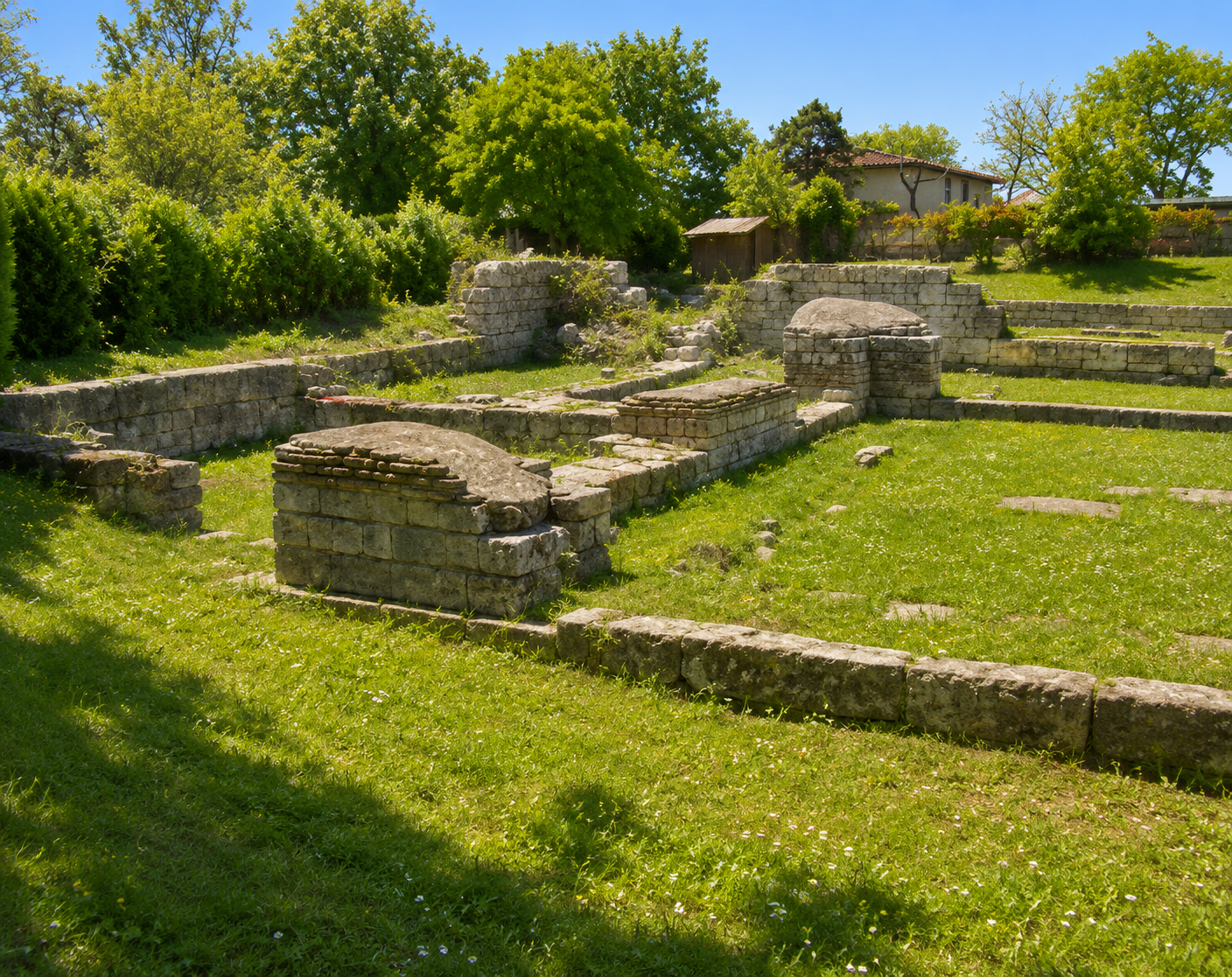
Callatis Fortress is the archaeological site of the oldest Greek colony on the present-day territory of the municipality of Mangalia, Constanța County, founded by colonists from Heracleea Pontica on the western coast of the Pontus Euxinus. It is the only former Doric colony on the Black Sea shore, unlike the other Pontic colonies — Histria and Tomis — which were Ionian colonies. The defensive wall was built at the end of the 4th century BC from large limestone blocks ranging in length between 0.70 and 1.15 m, laid without mortar. In the 1st century AD the walls were destroyed, only to be rebuilt during the Roman period along the same alignment — the second enclosure dating from the 2nd century AD. The fortress complex comprises 12 monuments: the Roman and Romano-Byzantine fortress, a basilica, two necropolises, early Christian hypogeal tombs with inscriptions, a tumular necropolis, the Greek colony, the defensive wall, the "papyrus" tomb, the tomb with a Scythian-type vault, and the enclosure wall. The Syrian-type basilica in the north-eastern corner of the fortress is unique in Dobrogea — the only Christian basilica in the region with its entrance facing north. The enclosure wall, rebuilt during the Roman period, can be seen today in the lobby of Hotel President in Mangalia, where architects have integrated it into the design, marking with different floor colours the original alignment of the wall as it continued towards the sea. The former port of the fortress lies beneath the waters of the Black Sea, and the archaeological site extends across the area between the Balneary Sanatorium, the House of Culture, Strada Constanței, the Esmahan Sultan Mosque and the entrance to the commercial port. It is well worth visiting for its exceptional stratigraphic layering spanning over two millennia and for its unique features — the papyrus tomb and the Syrian basilica — documented by archaeologists Vasile Pârvan and Radu Vulpe.
Mangalia judetul Constanta