
Attraction
Evangelical Cathedral of Saint Mary
The Evangelical Cathedral of Saint Mary in Sibiu is a Gothic monument built between the 14th and 16th centuries, with a tower 73.34 m tall, completed in 1494 — the tallest in Transylvania. The building holds notable medieval graves, including that of Mihnea the Wicked, son of Vlad the Impaler, and one of Central Europe's most valuable organs, dating from 1671. It stands in Albert Huet Square, in the heart of Sibiu's historic center, and became a cathedral in 1867.
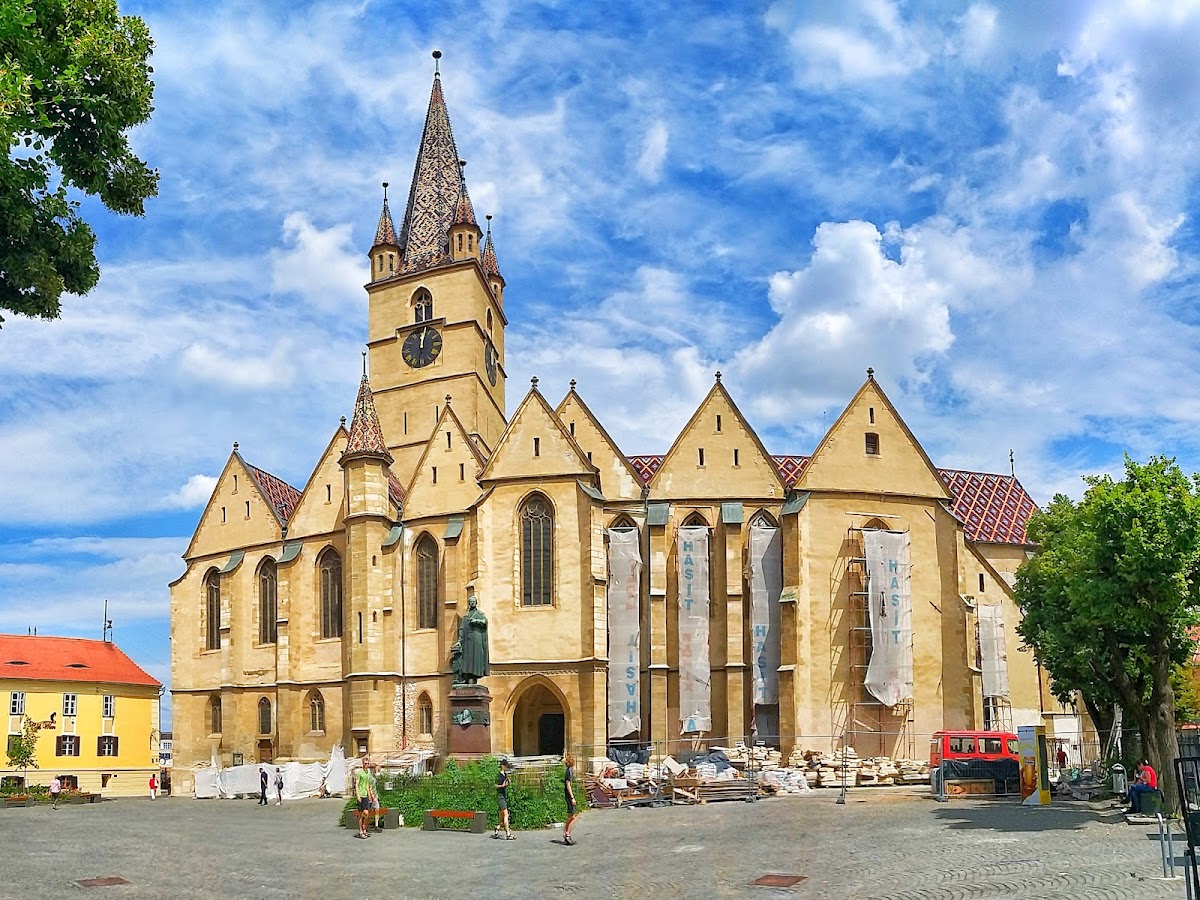
The Evangelical Cathedral of Saint Mary in Sibiu is one of Romania's most representative examples of Gothic architecture, built in several stages between the 14th and 16th centuries, on the site of an old 12th-century Romanesque basilica. Construction began around 1371, according to the first document mentioning the church's choir, and its current form dates from the 1520 renovation. The main tower, 73.34 m tall, was completed in 1494 and remains the tallest in Transylvania and the tallest building in Sibiu; its four corner turrets signaled the city's right to impose capital punishment (ius gladii). Local legend has it that Sibiu's Saxons wanted their tower to surpass the one in Bistrița, but Bistrița's craftsmen got them drunk at a feast and secretly cut a piece off the measuring rope — leaving Bistrița's tower "officially" the tallest in the region, at 75 m.
The cathedral's interior holds the graves of several notable figures from the Saxon community, buried inside the church until the mid-18th century — a custom banned in 1796, with the sole exception of Baron Samuel von Brukenthal (1803). Among the oldest gravestones are those of Georg Hecht (1496) and Nicolaus Proll (1499). The only Romanian buried here is Mihnea the Wicked, ruler of Wallachia and son of Vlad the Impaler, killed on the steps of the cathedral's south entrance in 1510 — accepted for burial here due to his Saxon maternal ancestry and his good relations with Sibiu's community, where he had spent part of his childhood.
The cathedral's Baroque organ was built by a Slovak craftsman in 1671, replacing the first organ brought to Sibiu in 1585. In 1914, the current great organ was installed, built by the German firm Wilhelm Sauer of Frankfurt an der Oder — the largest in Southeastern Europe at the time — fully restored in 1997 and still used today for concerts and religious services. The cathedral officially became an episcopal seat in 1867, when the Lutheran Saxon bishopric was transferred from Biertan to Sibiu.
The building has a longitudinal axis (excluding the tower) of 58.14 m, with a choir length of 17.37 m and a central nave height of 15.80 m. Climbing the tower involves about 192-200 steps, leading to a viewing point overlooking the entire historic center. The cathedral stands in Albert Huet Square, in the heart of Sibiu's historic center, and has been listed among Romania's historic monuments since 2004. Worth visiting for its well-documented architectural value, its collection of medieval gravestones, and its organ heritage of European importance.
Piata Albert Huet 1 Sibiu judetul Sibiu