
Attraction
Danube-Black Sea Canal
The Danube-Black Sea Canal links the port of Cernavodă, on the Danube, with the ports of Constanța, Midia, and Năvodari, shortening the route to the Black Sea by roughly 400 kilometres. The main canal runs 64.4 km and was inaugurated on 26 May 1984; the northern branch, Poarta Albă-Midia Năvodari, adds a further 31.2 km and was completed in 1987. It is Romania's largest hydraulic engineering work, and also the place where, between 1949 and 1953, a system of forced-labour camps cost the lives of thousands of political prisoners.
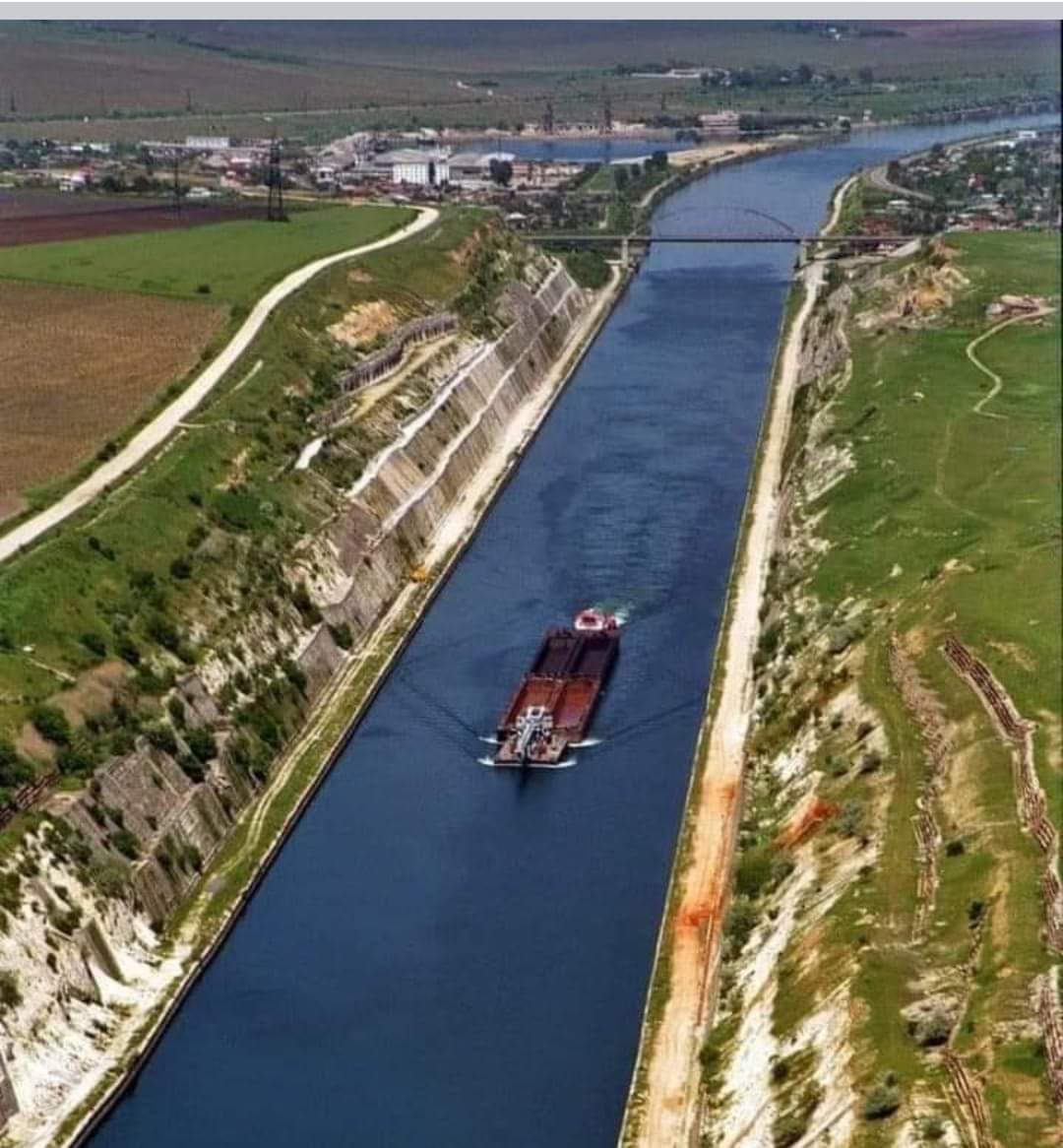
The Danube-Black Sea Canal is a navigable waterway in Constanța County, linking the port of Cernavodă, on the Danube, with the Black Sea ports of Constanța, Midia, and Năvodari. It shortens the route to Constanța by about 400 kilometres, cutting out the great bend the river makes downstream of Călărași.The system runs 95.6 kilometres in total. The main canal measures 64.4 km, with a depth of 7 metres, a width of 70 metres at the bed and 90 to 120 metres at the surface. The maximum permitted draught is 5.5 metres, allowing river vessels and small seagoing ships. The northern branch, known as the Poarta Albă-Midia Năvodari Canal, runs 31.2 km, with a depth of 5.5 metres and a width of 50 to 66 metres. There are four locks: two on the main canal, at Cernavodă and Agigea, and two on the northern branch, at Ovidiu and Năvodari.The route leaves the Danube at Cernavodă, follows the Carasu Valley, and crosses the Dobrujan plateau via Basarabi, Valea Seacă, and Straja, to the northern edge of Lake Agigea and on into the port of Constanța. The canal passes Cernavodă, Saligny, Mircea Vodă, Satu Nou, Medgidia, Castelu, and Poarta Albă, where it branches. Along the route lie three river ports, at Cernavodă, Medgidia, and Basarabi, plus the maritime port of Constanța-Sud.The idea is more than 170 years old. In 1850, the agronomist Ion Ionescu de la Brad wrote about the benefits of directing the Danube along a new navigable arm between Cernavodă and Constanța. There followed the project of the engineer Grigore Lahovary, drawn up with the Belgian J. Van Drunen in Brussels in 1883, and that of the engineer Basil G. Assan, in Bucharest in 1897, who concluded that the canal would be built because it was indispensable to Romania's economic future.The first phase of construction, between 1949 and 1953, is the darkest chapter in the canal's history. Work began under a decision of the Political Bureau of the Romanian Workers' Party dated 25 May 1949, with Soviet advice. The site operated as a system of forced-labour camps in which thousands of political prisoners died. Hence the name it holds in collective memory: the Canal of Death. Work was abandoned in 1953.The project was revived by a decision of June 1973, and the site reopened in 1975. This second phase, which no longer used political prisoners, involved more than 33,500 execution designs signed by over 1,000 specialists, the excavation of roughly 300 million cubic metres of soil and rock, and the pouring of more than 4 million cubic metres of concrete. Total investment came to around 2 billion dollars. Work on the main canal finished on 30 October 1983, and the official inauguration took place on 26 May 1984, in the presence of Nicolae Ceaușescu. The northern branch was built between 1983 and 1987.At the time of its opening, the canal was the third largest navigation canal in the world, after Suez and Panama. It forms part of the European waterway linking the Black Sea with the North Sea through the Rhine-Main-Danube Canal; goods from Australia and the Far East bound for Central Europe thus shorten their journey by 400 kilometres.The economic balance remains debated. Initial estimates projected recovery of the investment within fifty years. Annual operating revenues, however, stand at roughly 3 million euros, which would mean recovery over more than six hundred years.The Danube-Black Sea Canal is worth visiting for the engineering scale of the work, best seen at the Agigea lock or at Cernavodă, where international shipping traffic can be watched, and because it is one of the few places in Romania where a major technical achievement and a chapter of political repression occupy exactly the same ground.
Cernavoda judetul Constanta