
Attraction
Ursulines' Church, Sibiu
The Ursulines' Church in Sibiu, on Gheorghe Magheru Street, was originally built in 1479 by Dominican monks, in Gothic style, and rebuilt in Baroque style between 1728 and 1733 by Ursuline nuns, brought from Pojon (Bratislava) after Habsburg administration was established. The complex also included a girls' school, one of Sibiu's notable 18th-century educational institutions. Worth visiting for its rare architectural layering — original Gothic elements (buttresses, trilobate windows, west portal) coexisting with Baroque decoration — and for its significance in the history of Catholic education and religious life in Sibiu.
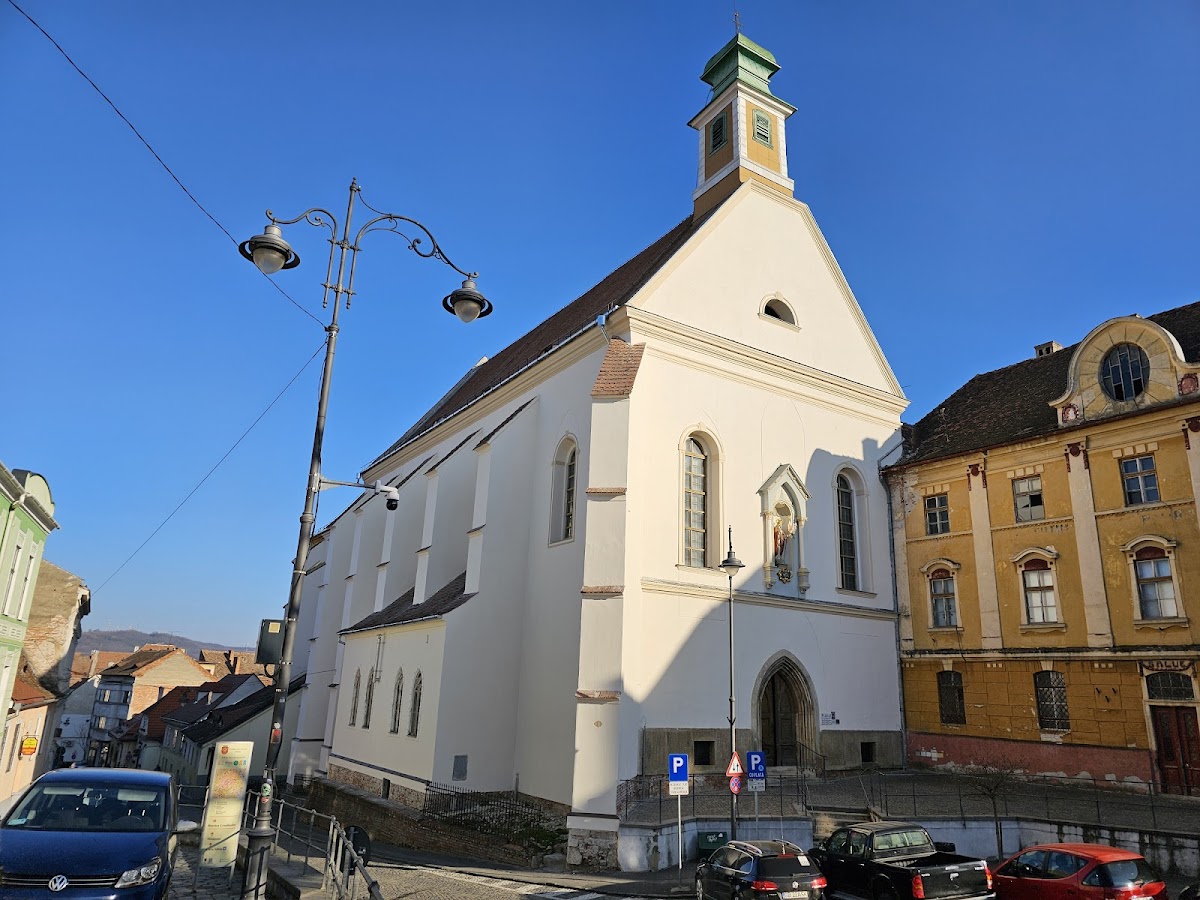
The Ursulines' Church in Sibiu is a religious building on Gheorghe Magheru Street (formerly Salt Street), in Sibiu's historic center. The first church on this site was built by Dominican monks in 1479, in Gothic style, replacing an even older 13th-century Dominican monastery, destroyed in 1241 by the Mongol invasion and damaged again by Turkish raids in 1432. In 1543, following the Protestant Reformation, the city's Saxon population converted to Lutheranism, and the church passed into Lutheran hands, remaining without a Catholic purpose for 150 years.
In 1728, after Transylvania was freed from Ottoman influence and Austrian administration was established, the former Dominican monastery complex was assigned to the Ursuline nuns, brought from Pojon (today Bratislava) — eight nuns, festively received on 12 July 1733. Between 1728 and 1733, the Ursulines rebuilt the church in Baroque style: the nave's Gothic vaults were replaced with a flat ceiling, and the Gothic buttresses were doubled on the interior with Baroque pilasters. Original Gothic elements survive only on the exterior — the buttresses, the trilobate windows on the upper section, and the pointed-arch entrance portal on the west facade — and in a side chapel and sacristy, the only spaces that kept their original style.
In 1734, the actual convent was built next to the church, and in 1769, with funds provided by Empress Maria Theresa, the complex was expanded to house a Catholic girls' school, with work completed in 1772. From 1789, the k.u.k. Normal School operated here, a continuation of the Jesuit Catholic gymnasium founded in 1774, becoming one of the city's elite schools. During the interwar period, both the elementary school and the "St. Ursula" Roman Catholic girls' gymnasium operated here; the institution was dissolved in 1948.
The complex — the church (code SB-II-m-A-12091.01) and the former convent, later the Pedagogical College building (code SB-II-m-A-12091.02, with renovations in 1733-1772 and 1891-1904) — is listed on Sibiu County's list of historic monuments. Worth visiting for its rare architectural layering, preserving both original 15th-century Gothic elements and the 18th-century Baroque transformation, as well as for its significance in the history of Catholic education and religious life in Sibiu.
Strada General Magheru 36, Sibiu