
Attraction
Holy Trinity Roman Catholic Church
The Holy Trinity Roman Catholic Church, at 3 Piața Mare, Sibiu, is a Baroque building built by the Jesuits between 1726 and 1733, representative of Habsburg influence on Transylvanian ecclesiastical architecture. It stands in Sibiu's historic center, which hosted the "European Capital of Culture" program in 2007. It is reached on foot from the city's central squares, with national road and rail connections.
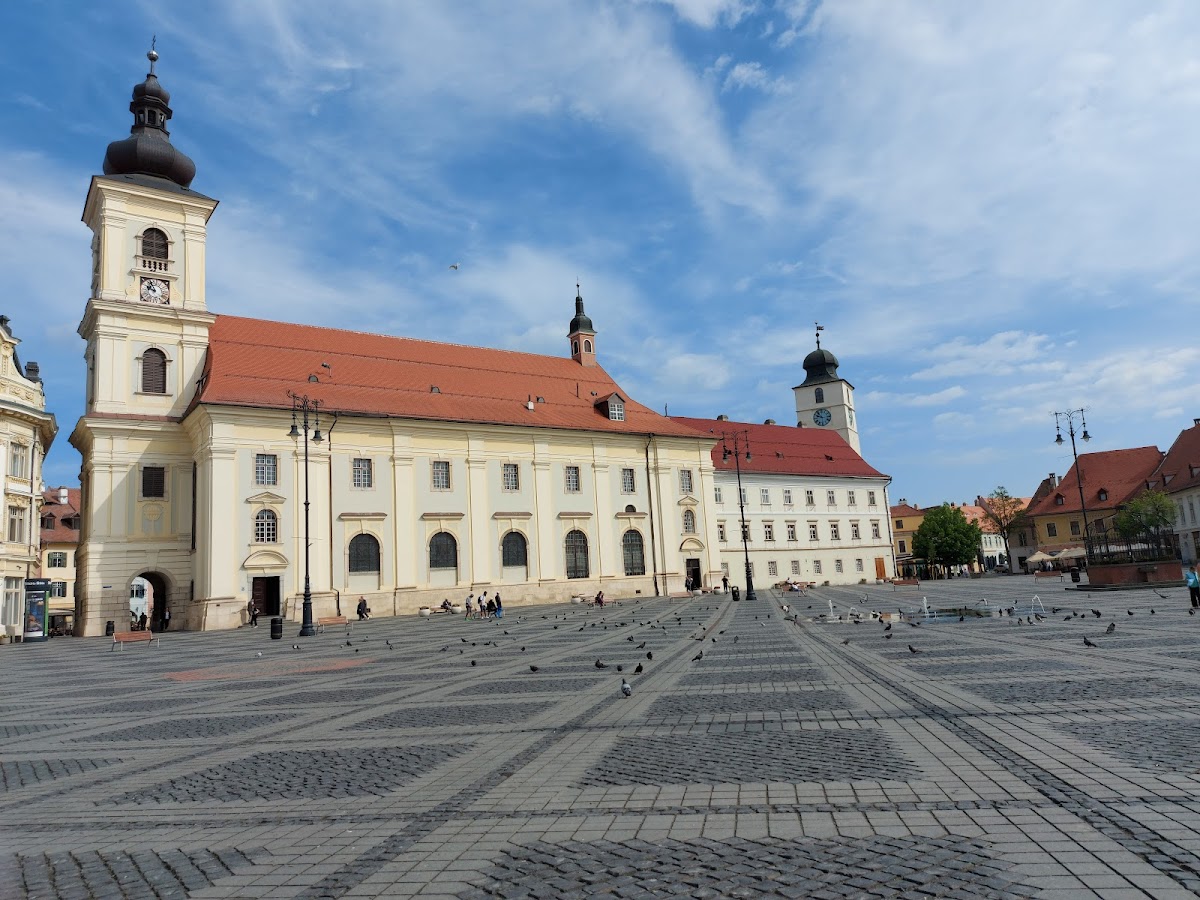
The Holy Trinity Roman Catholic Church stands at 3 Piața Mare, in the city of Sibiu, right in the historic center. The building belongs to Sibiu's Roman Catholic community and is one of the active houses of worship in the city's urban core. It was built by Jesuit monks between 1726 and 1733 — the foundation stone was laid on 4 July 1726, and the church was consecrated on 13 September 1733 by the Bishop of Transylvania, Georg von Sorger — on the site of the Tailors' Hall, where Catholic services had until then been held for the Austrian troops stationed in the city.
The church's facade shows features typical of early Viennese Baroque, sober on the outside, with stone door and window frames and a central escutcheon, contrasting with the richly decorated interior. The bell tower, detached from the nave, was completed in 1738 and stands 47 meters tall, housing three bells and a two-faced clock. The interior preserves liturgical furnishings and church painting from the same period, including the fresco behind the main altar, painted in 1777 by Austrian painter Anton Steinwald, and the funerary monument of General Count Otto Ferdinand von Abensperg und Traun.
Piața Mare, where the church stands, is one of Sibiu's central public spaces, surrounded by historic buildings representative of the city's medieval and Baroque architecture. In 2007, Sibiu was named European Capital of Culture — an EU title shared with Luxembourg — which spurred extensive restoration work in the historic center. However, Sibiu's historic center is not currently included on the UNESCO World Heritage List; a nomination dossier was submitted and rejected in the early 2000s, and the effort has been revived several times since, without success so far.
It is reached directly from central Sibiu, with Piața Mare accessible on foot from Piața Mică and Piața Huet, the three squares forming the city's historic core. The church is worth visiting for its Baroque architectural value and the dense historic urban context in which it stands, offering a concrete example of Habsburg influence on Transylvania's built heritage.
Piața Mare 3, 550163 Sibiu