
Attraction
Reformed Church in Mănăstireni
The Romanesque church in the village of Mănăstireni, about 18 km south-west of Huedin in the Călata region, was originally the church of a 13th-century monastery. It keeps its west tower, Romanesque carvings, a Gothic choir, a painted coffered ceiling from 1748 and an 18th-century stone pulpit, inside a shingle-roofed enclosure wall.
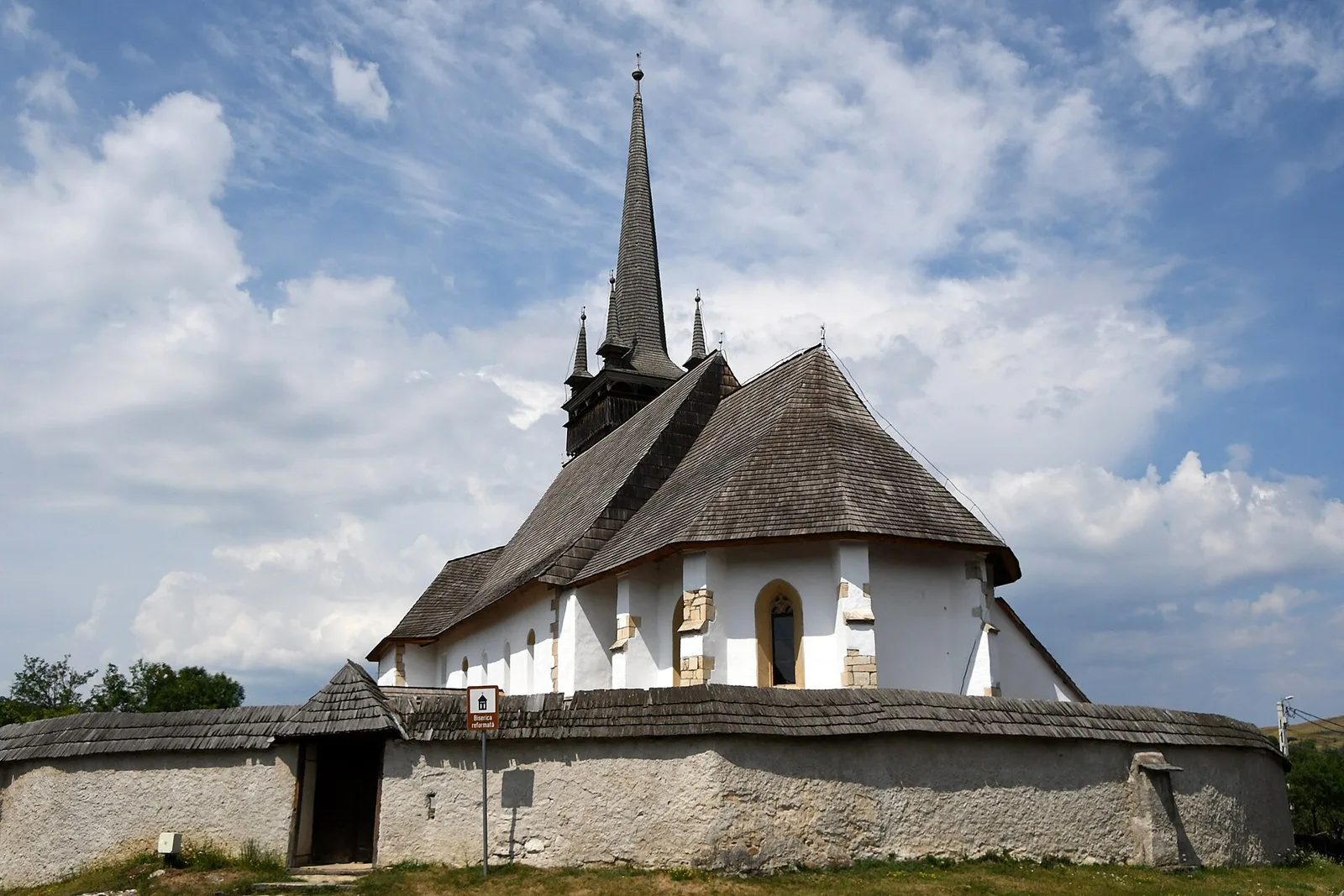
Foto: Pasztilla aka Attila Terbócs, CC BY-SA 4.0, via Wikimedia Commons
The Reformed church stands in the village of Mănăstireni (Magyargyerőmonostor in Hungarian), seat of Mănăstireni commune, about 18 km south-west of Huedin, in an upland area (around 750 m) where the Vlădeasa and Meseș mountains meet the Gilău Mountains. The village belongs to the Călata region (Kalotaszeg) and takes its name from the medieval monastery here.
The monastery was founded, probably in the early 13th century, by the Gerő branch of the Kalota kindred as a Benedictine family monastery. The village was plundered by the Tatars in 1241, and after the invasion the church received a pair of towers on its west front, of which only one survives; the other collapsed in an earthquake, and the repairs are marked by the year 1642 carved on the tower. The choir burned in the 15th century and was rebuilt in the Gothic style. The defensive wall, destroyed during Rákóczi's War of Independence (1703-1711), was rebuilt in 1734 by Ferenc Kabos. He also commissioned the painted coffered ceiling of the nave in 1748 and later the stone pulpit carved by the stonemason Dávid Sipos; the painted pews date from 1753 and 1758.
Today visitors can see the Romanesque nave with its original windows on the south side, the west tower with its shingled spire, the Romanesque carvings (a capital with two dragons, a relief of a saint fighting the dragon), the Gothic choir windows and, inside, the coffered ceiling, the pulpit and the painted furniture. The church is surrounded by a shingle-roofed stone wall with a wooden gate.
The Reformed Church in Mănăstireni is a category A historic monument, LMI code CJ-II-m-A-07706 (13th century, rebuilt in the 18th century), and belongs to the Reformed Church.
Did you know that the church's Romanesque carvings include a relief known as "Madárleány" (the Bird Girl)? Scholars interpret it as a provincial depiction of Lust (Luxuria), one of the seven deadly sins.
Sat Mănăstireni nr. 307, comuna Mănăstireni, județul Cluj