
Attraction
The Fortified Church of Șura Mare
The fortified Evangelical church of Șura Mare, Sibiu County, was built in the 13th century as a Romanesque Catholic basilica dedicated to the Virgin Mary. Partly destroyed by the Ottomans in 1493, it was rebuilt and fortified in the years that followed, receiving the bastion above its chancel in 1563. Of the enclosure that once surrounded it, only one defensive tower and two fragments of wall remain. The tower carries a four-faced clock, installed in 1854 and still running.
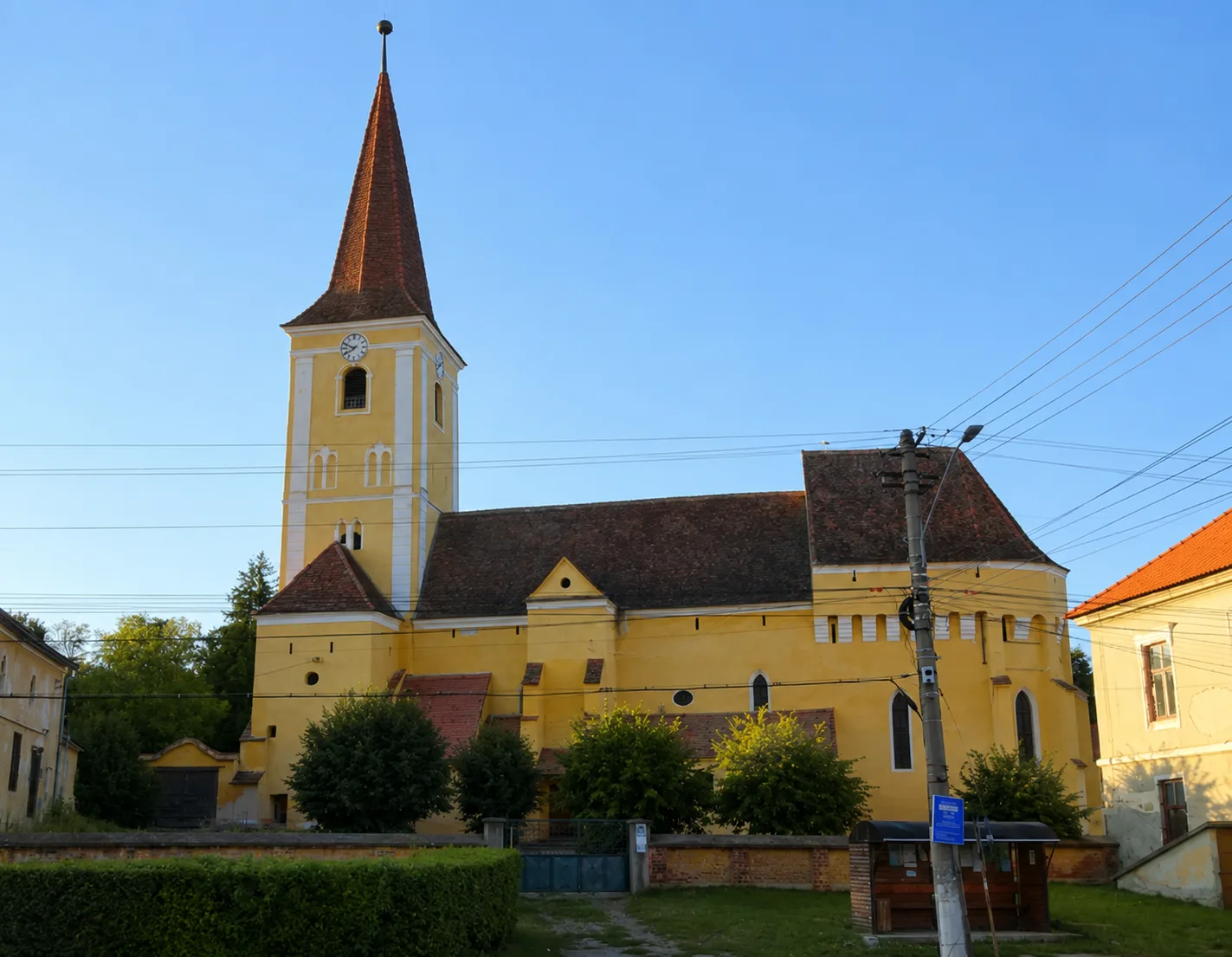
The fortified Evangelical church of Șura Mare stands in the seat village of the commune of the same name, Sibiu County, immediately north of the city of Sibiu. In German the village is called Großscheuern, in the Saxon dialect Griußscheiern, and in Hungarian Nagycsűr. It is a listed historic monument, the ensemble coded SB-II-a-A-12565.
Șura Mare is among the oldest settlements around Sibiu, founded between 1142 and 1162, and thus of an age comparable with the city itself. The earliest documentary mention records it in Latin as Magnum Horreum, the Great Barn, sometime between 1332 and 1335, and later as maior villa Horrei.
The church was raised in the 13th century, as a Catholic place of worship. The old Romanesque basilica was dedicated to the Virgin Mary and belonged to a type of basilica widespread in the Sibiu area, confirmed by the eastern apsidioles of its side aisles, similar to those at Cisnădie, Cisnădioara, and above all Gușterița. It was unusually long and had a three-storey bell tower above the western end of the central nave, open at ground level as a cross-vaulted porch. Its three-nave system, divided by a row of arcades, is still visible today.
In 1493 the church was partly destroyed by Ottoman armies. In 1494 the community received aid from the Seven Seats and the Seat of Sibiu for its rebuilding, and the works concluded in 1497. The building was fortified at the same time. Two storeys were added to the tower, with the bells on the topmost level and, above them, a wall-walk borne on wooden corbels. The flat ceiling of the central nave was replaced by a barrel vault with penetrations, built lower than the demolished ceiling; the nave walls were raised by about two metres and loopholes were opened. The chancel was buttressed on the outside, and its semicircular apse was demolished.
In 1563 the bastion above the chancel was completed, its corbels resembling those of the fortified church at Boz. The bastion was entered through the western bell tower and the church loft. Above the southern portal, a flanking tower was raised for better defence, similar to those at Cisnădie and Șeica Mică.
The third major phase came in 1854, once the Ottoman incursions had ended. The bell tower was rebuilt, the wall-walk demolished and a new level added, and the roof reconstructed. The tower received a clock with four faces, one on each side, still running today. At the same time the Gothic paintings were removed; traces survive on the northern side of the altar, and fragments of fresco were rediscovered in 1979. The organ, built in 1807 by Melchior Achxs, is now in poor condition, out of tune and worm-eaten.
Of the fortified enclosure that once surrounded the church, only a defensive tower and two fragments of wall survive, on the western side.
Șura Mare has also given and hosted figures who shaped Transylvania's history. Friedrich Teutsch was a priest here between 1896 and 1903, and three years later became bishop of the Evangelical Church in Romania. In the Evangelical Lutheran cemetery lies a plot laid out in 1975, where one hundred and sixteen German soldiers of the Second World War are buried.
The church is visited by arrangement, the key being kept by a family in the village.
The fortified church of Șura Mare rewards a visit for the way six centuries of differing needs can be read one over the other: a Romanesque basilica raised for prayer, turned into a stronghold after the Turks burned it, then stripped of its fortifications in the 19th century, when the danger had passed, and crowned with a clock that still keeps time.
Sura Mare judetul Sibiu