
Attraction
Hărman Fortified Church
The Fortified Evangelical Church of Hărman is a medieval ensemble built on the foundations of a 12th-century Romanesque basilica, expanded and fortified between the 15th and 17th centuries with 12-metre-high enclosure walls, seven defensive towers and a triple defensive perimeter. Hărman, known in German as Honigberg — "Honey Mountain" — is located in Țara Bârsei, approximately 10 km east of Brașov. Listed historical monument, LMI code BV-II-a-A-11715.
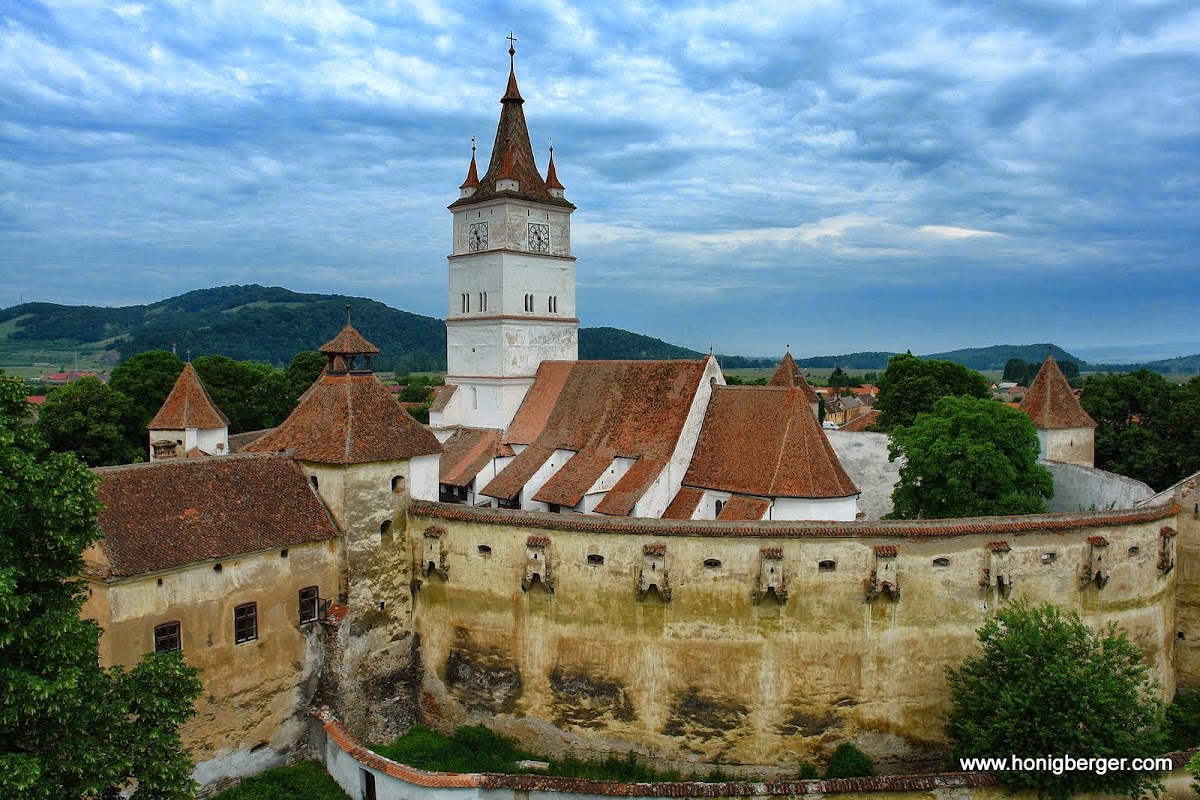
The Fortified Evangelical Church of Hărman is one of the most impressive examples of Saxon military architecture in Țara Bârsei, located in the commune of Hărman, Brașov County. The history of the site is connected to the presence of the Teutonic Knights in the region between 1211 and 1225; the first structure was a Romanesque basilica built in the 13th century on the foundations of an even older edifice dating from the 12th century, with Cistercian influences visible particularly in the eastern part of the nave. The locality is first mentioned in documents in 1240 under the name Honigberg — "Honey Mountain" in German — a toponym linked to local legends about bees. In response to the repeated Ottoman and Tatar threats of the 15th–17th centuries, the Saxon community erected a complex defensive system around the church: a massive enclosure wall 12 metres high, reinforced by seven defensive towers connected by a sentry corridor, a second outer circular wall approximately 5 metres high, and a water-filled moat equipped with a drawbridge. The ensemble was never conquered. The bell tower, added around 1300 and later heightened, dominates the landscape and is visible from a distance — its four corner turrets signified the locality's right to apply capital punishment. The church interior preserves a Baroque altar made in 1787 by the sculptor Franz Eberhard. Today, the space within the walls houses an ethnographic exhibition featuring objects belonging to the local Saxon community. Listed historical monument.
Strada Bisericii Hărman